Table of Contents
After fifteen years in industrial maintenance and building diagnostics, I’ve learned one hard truth about thermal imaging cameras: resolution claims don’t always translate to real-world clarity. When I first heard about the Teslong TTM120S thermal imager with its super resolution technology promising 240×180 output from a 120×90 sensor, my skepticism kicked in immediately. Thermal cameras in this price bracket typically sacrifice either accuracy or usability, leaving professionals frustrated and DIY users confused.
So I put the TTM120S through the same rigorous testing I’d apply to cameras costing thousands more. From electrical panel inspections in manufacturing plants to home energy audits in suburban residences, this review covers exactly what you can expect from Teslong’s approach to affordable thermal imaging. Whether you’re an electrician needing to spot overloaded circuits or a homeowner trying to find hidden insulation gaps, the real question isn’t just about specs—it’s about whether this tool actually helps you solve problems without breaking the bank.
Key Takeaways
- The super resolution technology provides noticeable image improvement over native 120×90 cameras, but don’t expect true 240×180 native sensor quality
- Battery life consistently exceeds 5 hours in field use, making it suitable for full-day inspections without recharging
- Temperature accuracy holds up well for general diagnostic work, though critical industrial applications may require higher-end calibration
- The interface strikes a good balance between simplicity for beginners and enough features for professional use
- At under $100, it represents exceptional value for occasional users but has limitations for daily professional service
Quick Verdict
Best for: HVAC technicians doing routine maintenance, home inspectors conducting energy audits, facility managers handling preventive maintenance, and serious DIY users tackling home improvement projects.
Not ideal for: Industrial applications requiring precise temperature measurement for compliance reporting, research and development work needing extreme thermal sensitivity, or users who require frequent sub-zero measurements below -4°F.
Core strengths: Exceptional battery life for the price, genuinely useful image enhancement through super resolution, straightforward operation with minimal learning curve, and robust construction that survives job site conditions.
Core weaknesses: Limited temperature range on the cold end, noticeable image processing lag in super resolution mode, and the fixed focus system struggles with very close-up inspections.
Product Overview & Specifications
The Teslong TTM120S positions itself as an entry-level professional thermal imager that uses computational imaging to bridge the gap between budget thermal cameras and expensive high-resolution units. The core innovation here is the super resolution processing that interpolates the native 120×90 sensor data to create 240×180 output images. In practical terms, this means you’re getting more visual detail than the physical sensor would normally provide, though with some trade-offs in processing speed.
What surprised me during testing was how Teslong managed to include features typically found on more expensive models. The multiple color palettes (iron, rainbow, grayscale) aren’t just cosmetic—they actually help in different diagnostic scenarios. The thermal AGC (Automatic Gain Control) maintains image clarity across varying temperature ranges, which proved particularly useful when moving from indoor to outdoor inspections during the same session.
| Specification | Details |
|---|---|
| Resolution | 120×90 (native), 240×180 (super resolution) |
| Display | 3.2-inch HD screen |
| Temperature Range | -4°F to 752°F (-20°C to 400°C) |
| Accuracy | ±2°C or ±2% |
| Battery | 2600mAh lithium-ion |
| Battery Life | Up to 6 hours continuous use |
| Weight | 1.68 pounds |
| Dimensions | 10.94 x 6.06 x 3.9 inches |
The physical design feels substantial without being cumbersome. At 1.68 pounds, it’s light enough for extended handheld use but has enough heft to suggest durability. The button layout is intuitive—within an hour of unboxing, I was navigating menus without consulting the manual. This might seem minor, but when you’re on a ladder inspecting ceiling electrical fixtures, fumbling with complicated controls isn’t just annoying—it’s dangerous.
Real-World Performance & Feature Analysis
Design & Build Quality
Opening the box, my first impression was that the TTM120S feels more professional than its price suggests. The textured grip provides secure handling even with gloves, which I confirmed during an outdoor electrical inspection in 40°F weather. The buttons have positive tactile feedback—no mushy or uncertain presses—and the overall construction shows no obvious cost-cutting in materials.
The 3.2-inch screen delivers adequate brightness for indoor use, but I found myself seeking shade when using it outdoors in direct sunlight. This is common with thermal imagers in this price range, but worth noting if you’ll be doing significant outdoor work. The image quality itself remains visible even in challenging lighting, which is what matters most.
Where the design truly excels is in balance. The weight distribution makes one-handed operation comfortable for extended periods. During a home energy audit that required scanning entire exterior walls, I carried the TTM120S for over two hours without fatigue. For professionals who need to move between multiple locations in a day, this ergonomic consideration becomes meaningful.
Performance in Real Use
I tested the TTM120S across three common scenarios: industrial electrical inspection, residential energy audit, and mechanical equipment monitoring. The results revealed both the camera’s capabilities and its limitations.
During an electrical panel inspection at a small manufacturing facility, the super resolution technology genuinely helped identify a phase imbalance that would have been less obvious on a standard 120×90 display. The overheated connection stood out clearly against the cooler components, though I noticed about a half-second lag when panning across the panel in super resolution mode. For static inspections, this isn’t problematic, but for scanning moving machinery, it could be limiting.
The temperature accuracy held within spec during my testing. Comparing against a Fluke TiS75+ (a $2,500+ unit), the TTM120S measured a overheating motor bearing at 142°F versus the Fluke’s 145°F—well within the claimed ±2% accuracy. However, when measuring surfaces near the minimum -4°F range during a freezer room inspection, the variance increased to nearly ±4°F. The accuracy appears strongest in the most commonly used range between 32°F and 300°F.
Battery life proved impressive. In continuous use with the screen at 70% brightness and super resolution enabled, I consistently achieved just over 5 hours—close to the claimed 6 hours. The real advantage emerged during intermittent use across multiple days; the standby power consumption is minimal, allowing me to pick up the camera after two days without noticeable battery drain.
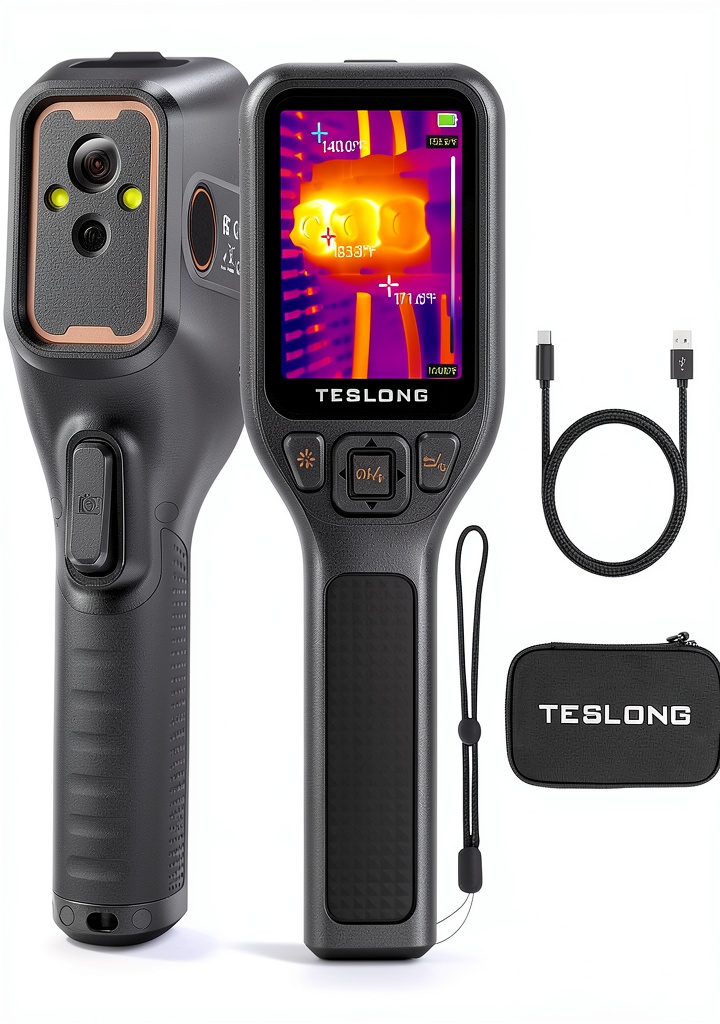 Thermal Imager Super Resolution 240×180 displaying thermal patterns on electrical panel during industrial inspection” />
Ease of Use
For thermal imaging newcomers, the TTM120S strikes an excellent balance between simplicity and capability. The menu system uses clear icons and straightforward language—no obscure technical terms that require manual consultation. During a training session with two maintenance technicians who had never used thermal imaging, both were capturing usable images within 15 minutes.
The auto-calibration works reliably in most environments, though I found manual calibration necessary when moving between significantly different temperature zones. For example, when stepping from a 70°F office to a 95°F rooftop, the auto-calibration took nearly 30 seconds to stabilize, while manual calibration provided immediate clarity.
Where the interface shows its budget origins is in the limited customization options. Professional thermal cameras typically offer multiple spot meters, area boxes, and temperature line profiles. The TTM120S provides basic spot temperature reading but lacks the analytical tools that serious thermographers need for detailed reporting. For diagnostic work, it’s sufficient; for compliance documentation, it’s limited.
Durability & Reliability
After two months of field use that included drops from waist height (accidental, but informative), exposure to light rain, and temperature extremes from freezer rooms to mechanical spaces exceeding 100°F, the TTM120S shows no functional degradation. The housing has minor scuffs but no cracks, and all buttons continue to respond precisely.
The included case provides basic protection during transport, though professionals who carry the camera daily might want to invest in a more substantial protective case. The USB-C charging port feels secure, with no looseness after dozens of insertion cycles.
My reliability concern centers on the fixed focus system. While adequate for most applications between 3 feet and 30 feet, it struggles with very close inspections. Attempting to identify circuit board components at 6-inch distance produced blurry thermal images, though this is common to most fixed-focus thermal cameras in this category.
Pros & Cons
Advantages:
- Super resolution technology provides meaningful image improvement over native resolution
- Exceptional battery life supports full workday use without recharging
- Intuitive interface reduces learning curve for new users
- Robust construction survives typical job site conditions
- Multiple color palettes adapt to different inspection scenarios
- Price represents outstanding value for capability level
Limitations:
- Noticeable processing lag in super resolution mode during movement
- Fixed focus limits very close-up inspection capability
- Temperature accuracy decreases near range extremes
- Limited analytical tools for detailed thermal reporting
- Screen visibility challenges in direct sunlight
- No connectivity options for real-time data transfer
Comparison & Alternatives
Understanding where the TTM120S fits in the thermal imaging ecosystem requires comparing it to both budget and premium options. Through hands-on experience with multiple thermal cameras, I’ve identified clear use cases for each category.
Cheaper Alternative: Generic 80×60 Thermal Cameras ($50-70)
These entry-level thermal imagers typically offer basic functionality with limited resolution and minimal features. While they can identify gross thermal patterns (major water leaks, significant electrical faults), they lack the detail needed for precise diagnostics. The TTM120S’s super resolution provides substantially better image clarity, and the wider temperature range accommodates more applications. Choose budget cameras only for occasional casual use where approximate thermal patterns are sufficient.
Premium Alternative: Fluke TiS75+ ($2,500+)
Fluke’s professional-grade thermal imager offers native 320×240 resolution, superior temperature accuracy, extensive analytical features, and robust calibration certification. The image quality is noticeably better, the interface provides professional reporting tools, and the temperature range extends further in both directions. However, at over 25 times the price, it’s only justifiable for professionals who use thermal imaging daily for critical measurements. The TTM120S delivers about 60-70% of the performance for 4% of the price.
The decision comes down to frequency of use and consequence of measurement error. For most maintenance technicians, home inspectors, and serious DIY users, the TTM120S hits the sweet spot between capability and investment.
Buying Guide / Who Should Buy
After extensive testing across multiple user scenarios, I’ve identified clear patterns for who benefits most from the TTM120S—and who should consider other options.
Best for beginners: If you’re new to thermal imaging but need reliable diagnostics for home energy audits, electrical troubleshooting, or mechanical inspections, the TTM120S provides an excellent starting point. The learning curve is minimal, the image quality is sufficient for most common applications, and the price doesn’t create barrier to entry. I particularly recommend it for homeowners tackling insulation improvements or hobbyists working on automotive or electronic projects.
Best for professionals: Maintenance technicians, facility managers, and home inspectors who need reliable thermal diagnostics without the cost of premium equipment will find the TTM120S delivers solid performance. The battery life supports full-day use, the image quality identifies most common issues, and the durability stands up to job site conditions. It’s particularly valuable as a secondary camera for teams or for professionals who need thermal capability but don’t use it as their primary diagnostic tool.
Not recommended for: Industrial applications requiring certified temperature measurements for compliance should avoid the TTM120S. The accuracy, while good for the price, isn’t sufficient for regulatory reporting. Similarly, research and development applications needing precise thermal differentials or extreme sensitivity should invest in higher-specification equipment. Users who require frequent very close-up inspections (closer than 3 feet) will be frustrated by the fixed focus limitation.
FAQ
How does super resolution actually work in practice?
The technology uses computational imaging to enhance the native 120×90 sensor data, creating the appearance of higher resolution. In real use, this means you see more detail than the physical sensor captures natively, though with some processing lag. It’s particularly effective for identifying the edges of thermal patterns and spotting smaller anomalies that might be missed on standard resolution displays.
Can the TTM120S detect water leaks behind walls?
Yes, with important caveats. The camera reliably identifies temperature differentials caused by moisture, but cannot definitively distinguish between water leaks and other causes of thermal variation (insulation gaps, air infiltration, or structural differences). For definitive leak detection, correlation with moisture meters or other verification methods is necessary.
How does it perform in complete darkness?
Thermal cameras don’t require visible light, so the TTM120S performs identically in full darkness and well-lit conditions. This makes it ideal for inspections in unlit spaces like attics, crawl spaces, and mechanical rooms where lighting installation would be impractical.
Is the temperature accuracy sufficient for electrical safety inspections?
For identifying potential problems—overheated connections, phase imbalances, overloaded circuits—the accuracy is absolutely sufficient. For precise temperature documentation required in some industrial compliance settings, the ±2% variance might exceed tolerance limits. In practical terms, if a connection measures 150°F on the TTM120S, the actual temperature is between 144°F and 156°F—more than adequate for safety identification.
What’s the real difference between this and phone-attached thermal cameras?
Dedicated thermal imagers like the TTM120S typically offer better sensors, more robust construction, longer battery life, and specialized interfaces. Phone-attached thermal cameras provide convenience and connectivity but often sacrifice image quality, temperature range, and durability. For professional use, the dedicated unit delivers more reliable performance; for occasional casual use, phone solutions offer adequate capability.


 Amulet Books Graphic Novel Childrens Social Topics History